
You can hire design consultants in-house or outsource the recruiting, and both work. In-house gives you more control and costs your own time. Outsourcing gives you a steady stream of screened candidates and costs you some say over the early steps. The right choice depends on how often you hire and who is available to chase candidates.
What makes this hire different
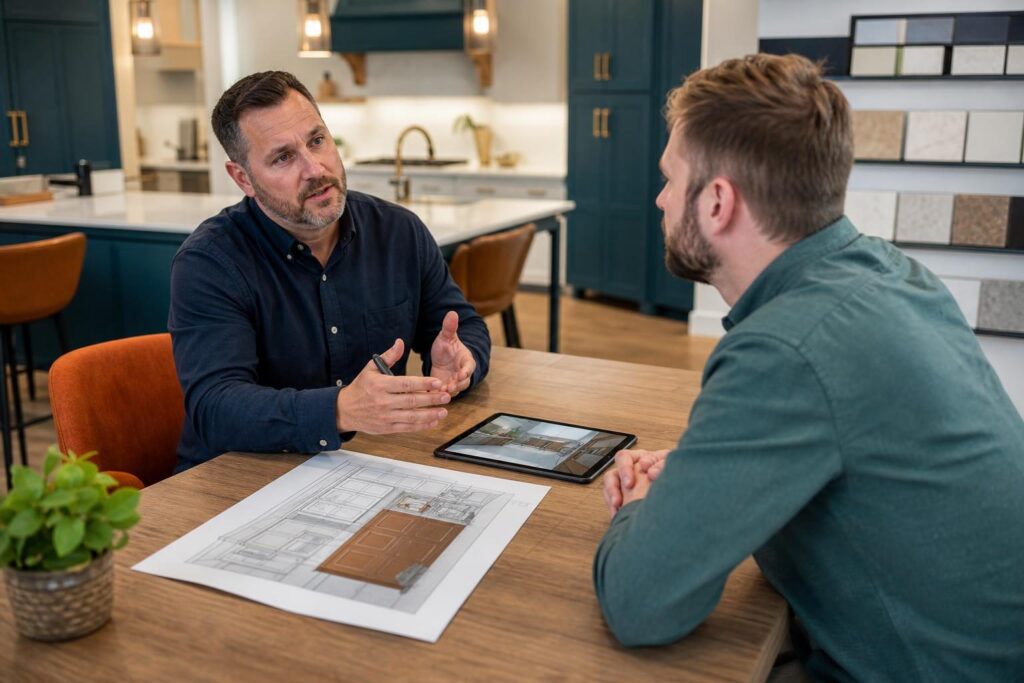
A design consultant runs an in-home appointment, designs the project, prices it, and closes it at the kitchen table. Remodeling is a big-ticket purchase decided at home, often with a couple who want time to think. That takes an experienced closer, not just someone who is good with people.
That narrows the pool. The strongest candidates often already sell something similar: windows, roofing, solar, bath systems, flooring, or other in-home, high-ticket products. They are usually employed, so they respond slowly and compare offers. Your process has to hold up while they decide.
Hiring design consultants in-house
In-house means you or your sales manager do the work, or you hire a recruiter to do it. The work is more than posting an ad:
- Write the job ad and post it on job boards and social platforms.
- Read every application and sort out who has in-home sales experience.
- Call or text candidates, then keep following up with the ones who go quiet.
- Schedule interviews and re-schedule the no-shows.
- Run the interviews, ride-alongs, and offers.
Where in-house wins: You control the message and the first impression. Your best reps can refer people they trust, and a referred closer is often the best hire you will make. If you hire once or twice a year and have time to be thorough, doing it yourself can be the cheapest route in cash.
Where it breaks: The sales manager doing the recruiting is the same person who should be coaching reps and sitting on appointments. Recruiting gets squeezed in between and slips when the schedule fills up. Follow-up is the usual casualty. Candidates who applied on Tuesday and heard nothing until Friday have often taken another offer. If you are weighing a full-time recruiter, our comparison with hiring an in-house recruiter covers that trade-off in more detail.
Outsourcing the recruiting
Outsourcing means a partner finds applicants, screens them, follows up, and gets them onto your calendar. You still decide who gets hired. You are handing off the sourcing, sorting, and chasing.
Where outsourcing wins: Speed and consistency. Applicants are screened as they apply, and follow-up does not depend on someone remembering to call. It also helps when you want a standing pipeline instead of a scramble each time a rep leaves or you open a new territory.
Where it falls short: A partner cannot judge your culture or your sales style for you. You will meet some candidates who look right on paper and are wrong in the room. Outsourcing also has a cost every month or every hire, so you need to hire often enough for it to pay off. And you have to give clear requirements up front, because the screening only filters on what you tell it.
Side by side
- Time from you: In-house takes hours every week during a search. Outsourced takes setup time and interviews.
- Speed: In-house depends on your calendar. Outsourced follow-up runs continuously.
- Control: In-house gives you every step. Outsourced gives you the final say, with less control of the early steps.
- Cost: In-house is mostly your time, plus ad spend and tools. Outsourced is a fee, but it frees up your time.
- Best for: In-house suits occasional hiring and strong referral networks. Outsourced suits ongoing or urgent hiring.
Plenty of companies do both: referrals and their own network for the best candidates, an outside pipeline for volume.
Screening that matters either way
Whoever does the recruiting, the filter should be the same. Make a short list of hard requirements and screen on them before anyone takes an interview slot.
- In-home, big-ticket sales experience. Ask what they sold, the average ticket, and whether they ran the appointment alone.
- Comfort with commission. Say how pay works in the ad and in the first screen. Surprises here cause early quits.
- Transportation, availability, and evening hours. Appointments happen when homeowners are home.
- Licensing and registration. Some states require home improvement salespeople to be registered or licensed, and others do not. Check your state and local rules, and your own insurer’s, before you make offers.
Then test the skill. Ask a candidate to walk you through their last closed deal and their last lost deal. A strong rep can explain both in detail. A short role play of a first appointment shows how they ask questions and handle the “we need to think about it” response. If possible, finish with a ride-along or a second interview with your sales manager.
Where Recruitomatic fits
If you outsource, Recruitomatic launches your campaign within 48 hours, writes the ads, builds screening questions for in-home sales experience, and follows up by text, email, and calls until candidates book. Confirmed interviews land on your calendar. You can see how that works on the how it works page or read about our remodeling recruiting approach.
How to choose
Ask yourself three questions. How many design consultants will you hire in the next twelve months? Who will do the follow-up, and will they actually do it every day? What does an empty territory cost you each month in missed app