
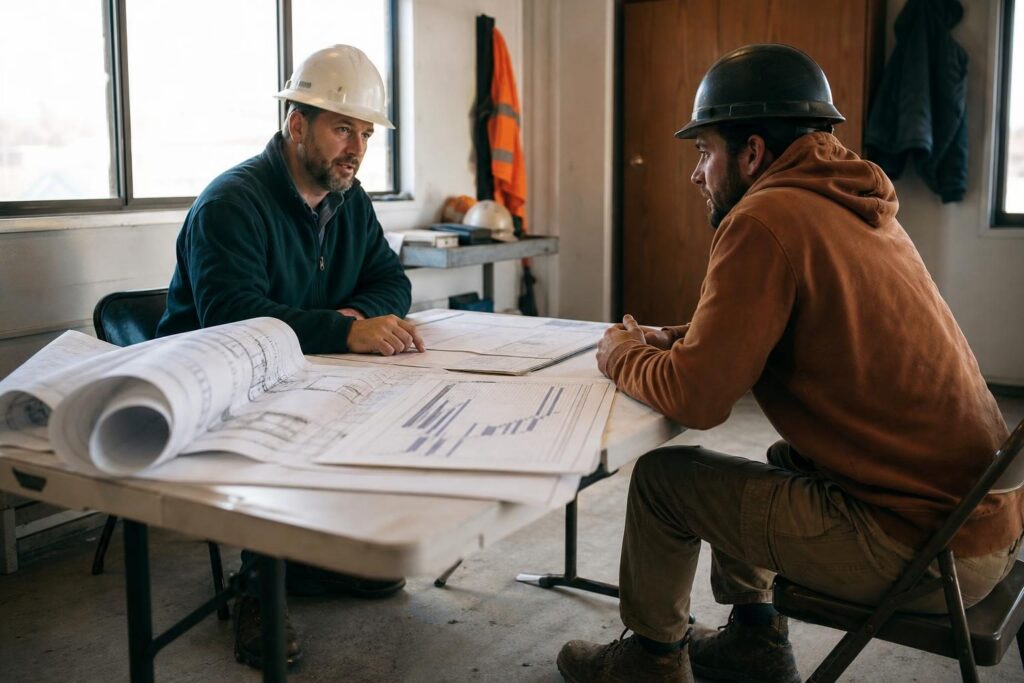
Hire superintendents and project managers in-house if someone on your team has the time to chase employed candidates, a real network in your trade, and a reason for those candidates to take the call. Outsource the search if you don’t, or if a contract start date is closer than your pipeline. Most contractors end up with a mix: owner-led referrals, plus outside help on sourcing and screening.
Why these two roles are different from hiring a crew
Laborers and carpenters are hired in volume, and plenty of them are actively looking. Superintendents and project managers are the opposite. The good ones are employed, running a job right now, and not scrolling job boards. They hear about openings from people they know.
The timing is also unforgiving. A new contract sets the headcount, and someone has to own the schedule, the subs, and the budget by the start date. Waiting for the right résumé to show up in an inbox is not a plan.
Hiring in-house: what it takes
Doing it yourself works best when you have these things:
- A network you will actually use. Your best source is people who have worked with or against these candidates: subs, suppliers, architects, owners’ reps.
- Someone with time to make calls. Reaching out to employed people is slow, and most of them say no the first time.
- A pitch. Strong candidates want to know the project types, the size of the jobs, who they report to, and how you treat people when a job goes sideways.
- Lead time. If you know a year out that you need a second superintendent, you can build relationships before you need them.
The upside is control and cost. You know your culture better than any outsider, and the candidate hears it from the person they will work for.
Where in-house breaks down
The usual failure is that the owner or operations lead is also running jobs. Recruiting gets done at night, candidates wait days for a reply, and the good ones take another offer. A second failure is relying on a job ad alone for roles where the best people are not looking. You get applicants, but not the people you wanted.
A third is screening by gut. When you are desperate for a start date, it is easy to talk yourself into a candidate whose experience is in a different kind of project.
Outsourcing: what it does and does not do
Outside help takes the sourcing, outreach, and first-round screening off your plate so you spend your time on finalists. For senior roles, this usually means a targeted search, not a posted ad. That is the idea behind executive search: find people who are not applying, confirm the basics, and put the right ones in front of you.
What outsourcing does not do is make the decision. You still need to interview, check references, and decide whether someone fits how you run work. A recruiter can confirm that a candidate has run jobs of your size. Only you can judge whether you want them on your site.
Recruitomatic handles this kind of search for construction and other trades. For the crew roles around those leaders, our construction recruiting campaigns screen on years of experience, tools, transportation, and safety training before anyone reaches your calendar.
A side-by-side look
- Speed: In-house moves at the pace of whoever has spare time. Outsourced work is someone’s full-time job, which helps when a contract has a hard start date.
- Reach: In-house reaches your network. Outsourced reaches strangers, including employed people you would never have found.
- Control: In-house wins. You pitch every candidate yourself.
- Screening consist